
Advanced
Imaging for Better Dental Care
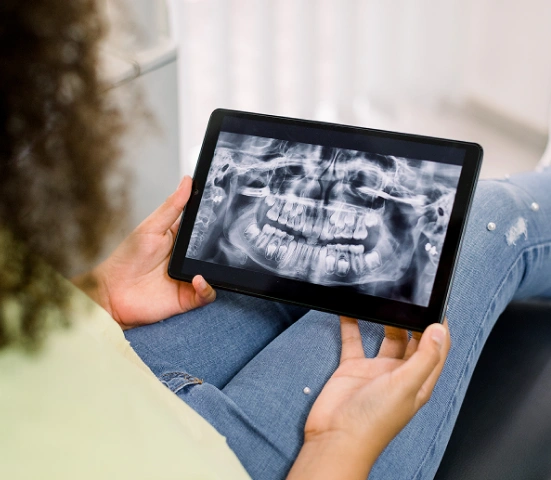
Modern dentistry depends on accurate diagnosis and careful treatment planning. Dental X-rays have long been a key tool for identifying problems that can’t be seen during a routine exam. Today, digital X-ray technology makes this process safer, faster, and more comfortable for patients of all ages. At Long Island Family Dental, we use advanced digital dental imaging and 3D cone beam technology to ensure precise care in a comfortable setting.
We Use Digital Dental Imaging and 3D Cone Beam Technology
Digital Radiography offers immediate results for faster diagnosis & treatment planning, no waiting time for developing, and a significant reduction in radiation exposure, up to 80%.
Radiographs can be viewed on a computer monitor visible to both doctor and patient. All radiographs are taken with lead aprons equipped with protective thyroid collars to keep radiation minimal and safe for patients of all ages.
Benefits of Digital X-Rays
X-rays allow us to see beneath the surface of your teeth and gums. They reveal cavities hidden between teeth, bone loss caused by gum disease, impacted teeth, and even early signs of infection. Without this information, some conditions may go undetected until they cause pain or require more complex treatment.
Digital imaging improves this essential diagnostic tool by providing clearer images with significantly less radiation exposure than traditional film X-rays.
Patients often notice several advantages when digital radiography is used:
- Lower radiation exposure – Up to 80% less than traditional X-rays
- Instant results – Images appear on-screen within seconds
- Clearer detail – Enhanced images improve accuracy in diagnosis
- Eco-friendly – No chemicals or film processing required
- Better communication – Images can be enlarged and displayed so patients clearly understand their treatment options
What 3D Cone Beam Imaging Adds
In addition to standard digital X-rays, we use 3D cone beam technology for advanced cases. This type of imaging creates a three-dimensional view of the mouth and jaw, giving us precise information for:
- Planning dental implant placement
- Evaluating wisdom teeth and impacted teeth
- Assessing bone density and structure
- Diagnosing TMJ or jaw joint concerns
- Identifying infections or pathology
This detailed view ensures safer procedures and better treatment outcomes.
Are Digital X-Rays Safe?
Yes. Digital radiography uses a fraction of the radiation that older film X-rays required. Combined with the protective measures we use, such as lead aprons and thyroid collars, digital X-rays are safe for children, adults, and even expectant mothers when needed.
Because radiation exposure is so low, digital X-rays can be taken more frequently if necessary to monitor ongoing dental conditions or treatment progress.

Schedule
Your Appointment Today
If it’s been a while since your last dental exam, or if you’re starting a new treatment, digital X-rays may be an important part of your care. Call (631) 423-5200
or visit us at 931 Walt Whitman Rd, Melville, NY 11747 to schedule your appointment today.